The demand for renewable energy sources has been increasing in recent years as fossil fuels deplete. To date, solar energy has been supplying about 14% of the world’s energy demand, and it is expected to increase in the future.
Solar energy generated from the sun is one of the most used renewable energy sources. It is utilized in many technologies, including solar cookers, solar water heating systems, solar dryers, and more.
These days, solar cooker has become a favorable application especially in rural areas, as it facilitates environmentally friendly renewable sources of energy and reduces dependence on conventional power sources.
Photo by Black and Silver Solar Panels from pexels.com
What is a solar cooker?
A solar cooker is one of the most significant solar energy applications. A solar cooker can be used to cook, pasteurize, and sterilize by harnessing direct sunlight. This cooking appliance exploits the energy of the sun by absorbing solar radiation and transferring it into heat that can be transmitted into food through cooking pot walls.
In addition to being used to heat or cook food or beverages, it can also be used to pasteurize and sterilize water, which is useful in places where safe drinking water is difficult to obtain.
These cookers are best suited for sunny places with limited sources of energy. As they do not require any fuel, they do not cause environmental pollution which makes them a better alternative to conventional cookware.
How does a solar cooker work?
The technology behind a solar cooker is based on a simple science theory, which is converting light energy into heat energy.
A solar cooker is an appliance that absorbs UV light rays from the sun and converts it into heat. The heat is retained in the lid-covered pot and transmitted to food through the cooking pot walls. The radiation of this energy makes water, fat, and protein molecules in food vibrate vigorously and heat up.
Thus, the effectiveness is highly dependent on the ability of the cooking vessel to retain heat energy.
Types of solar cookers
Solar cookers are classified into direct or indirect solar cookers depending on the heat transfer mechanism. Direct ones use sunlight directly for the cooking process, whereas the indirect type requires a heat transfer liquid to transfer heat to the cooking pot.
The three main cookers on the market today are parabolic solar cookers, box solar cookers, and panel solar cookers, all of which use direct sunlight for cooking. The best solar cooker would be the one that works best for you.

Photo by tunfux from pixabay.com
Parabolic solar cookers
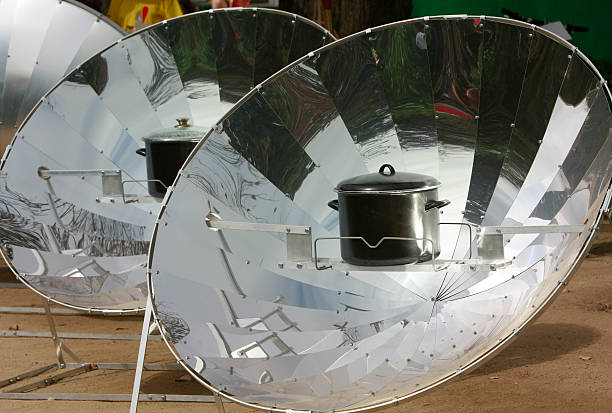
Parabolic solar cookers are also known as parabolic reflectors. This device works like a magnifying glass that uses a reflector to gather a large surface of sunlight and reflect them onto the cooker.
This type of cooker is characterized by its short cooking time due to the high temperatures that it can reach. Food can be cooked directly by absorbing the heat from the sunlight without the interference of any material between the sunlight and the cooking pot. Besides, some of the parabolic cookers are used for baking as well.

Photo by Cordelia Molloy from Science Photo Library
Box solar cookers
Box solar cookers work just like the slow cooker or oven you have at your home. They consist of a large reflective panel and an interior chamber with a single or double transparent window made of glass or plastic.
Solar radiation passes through the transparent window and is absorbed by the cooker inside the chamber. The reflective panels help concentrate more sunlight into the chamber, thereby trapping heat inside.
To increase the efficiency of the cooker, the inside of the box and the cooking pots should be painted in black to maximize the heating effect, a larger panel also produces more heat.
The window provides a greenhouse effect that allows solar radiation in but prevents it from getting out of the cooking pot. Food is cooked through the heat generated from the convergence of solar radiation.

Photo sourced from GoSun
Panel solar cooker
Panel solar cookers use reflectors to collect a large area of sunlight and direct it towards a black cooking pot placed in a high-temperature oven bag. The pot is surrounded by a transparent cover which stops heat from escaping to the environment, providing a greenhouse effect.
The mechanism is similar to a box solar cooker except that it utilizes a large reflective panel instead of an insulated box to direct sunlight onto the black cooking pot that converts into heat energy.
However, the downside of this cooker is that its effectiveness will be affected by the weather, and they are time-consuming as ‘pre-heating’ is required whereby they have to be placed under direct sunlight for a few hours before it can be used.

Photo sourced from Insteading
Solar cooker advantages and disadvantages
Advantages of solar cookers
Solar cooker is a remarkable invention that has benefited people from all economic levels in society and is proven to have the potential of replacing conventional cooking technologies.
In rural areas where firewood or animal dung is the main source of energy for cooking, solar energy could replace them to reduce health hazards and deforestation issues. Hence, this technology is said to have improved the quality of life due to its significant impact on the environment, economy, and health.
Below are some of the advantages that solar cookers possessed.
- Reduce carbon footprint. Unlike traditional cooking methods that utilize gas or firewood, solar energy is a renewable source of energy that cuts down on carbon footprint by reducing carbon dioxide gas emissions into the environment.
- Improve air quality. Solar cookers can improve air quality because electricity-powered cookers generated by coal and natural gas will contribute to air pollution.
- Safer. Solar cookers decrease the release of smoke from firewood that may be harmful to the eyes and respiratory system, especially for children.
- Convenient. Most solar cookers are designed to be portable, hence they can be carried around and used almost anywhere.
- Cheap. Building a solar cooker is relatively cheap and easy, and it can last for a long time as long as there is sunlight.
Disadvantages of solar cookers
The effectiveness of solar cookers is highly dependent on the weather. Here are some considerations when using a solar cooker.
- Sunlight is required. Solar cookers are greatly dependent on sunlight; without sunlight, the effectiveness of the cookers may not be as good because the temperature will not be high enough to heat the food.
- Weather dependent. As these cookers are used outdoors, they may lose effectiveness during the rainy or cold season when there is limited sunlight.
- Hard to control. Unlike electric or gas stoves where you can easily control the temperature, the temperature of solar cookers are hard to control. Cooking temperature can fluctuate depending on the sunlight available on that day.
- Time-consuming. Some cookers may require you to place them under direct sunlight for a few hours before it is ready for use.
- Only applicable to certain types of cooking methods. Most solar cookers are only available for stir-frying, baking, and light cooking. These cookers may not reach the suitable temperature used for frying.
Solar cooker price
The price of a solar cooker ranges from $50 to as high as $500 varying on its size, function, and brand. When looking for a solar cooker, remember to do your research and consider its temperature range, portability, reflective panels, and versatility.
Conclusion
A solar cooker is a type of solar thermal collector that harness the energy of the sun to cook food. Undoubtedly, they are beneficial to the economy, health, and environment. However, their effectiveness is greatly dependent on the weather condition.
They are also divided into direct and indirect solar cookers based on their heating mechanism with the three main cookers being parabolic, box, and panel solar cookers. Overall, it would be a good decision to invest in a solar cooker, but check the features of each cooker before making your purchase.