Dark, windowless spaces can make a home gloomy. So, how do you get natural sunlight into a basement? With solar tubes!
The basement is just an example of one of many interior spaces that can be lit up using solar tubes. Skylights can do the same thing too, but they are slightly different when it comes to solar tubes.
Solar tubes are gaining popularity and expanding their use cases, making the market outlook bright. As an affordable and energy-efficient lighting option, these light pipes are becoming increasingly popular in residential and commercial settings.
The global solar thermal market, which produces and uses solar energy to generate heat, is valued at $21.5 billion, and is expected to grow at a CAGR of 5.1% from 2022 to 2031, reaching $35.3 billion.
Homeowners and businesses are installing them to reduce electricity costs compared to traditional lighting. Demand for these innovative sunlighting systems continues to grow as more people seek out cost-effective, eco-friendly solutions for indoor lighting needs.
A recent article by Business Research Insights on: “Tubular Skylights Gain Popularity” says that sales of tubular skylights are increasing as cities try to become more energy-efficient and smart. These skylights use rooftop tubes to funnel natural light into buildings like stadiums and offices, reducing the need for artificial lighting
In this article, we take a look at all the aspects of solar tubes and how they compare with skylights with topics like what solar tubes are, costs, installation, and considerations for using them.
What is a solar tube?
The solar tube is also known as the sun tube, light tube, sun tunnel, tubular skylight and daylight pipe. It looks exactly like a tube, thus its name. The solar tube mentioned here is not to be confused with thin-film agri voltaic solar tubes and photovoltaic solar tubes which are mainly made for generating electricity.
These daylighting systems capture and transfer sunlight indoors through reflective tubing. For example, a dome on the roof collects light into a highly reflective tube that angles into a ceiling fixture, diffusing light evenly.
This provides natural illumination without skylights or wiring. Other names for solar tubes include sun scope, light tube, and tubular daylighting device (TDD).
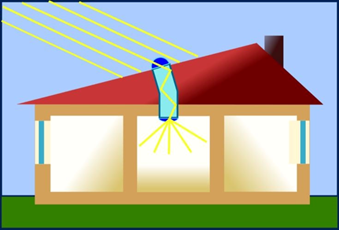
A solar tube is made from metal. The end of the tube that receives sunlight is called the dome and it is made from a translucent, weather-resistant material. The other end is covered by a diffuser, which dissipates sunlight into the interior space.
The inside of the solar tube is lined with a super-reflective coating which amplifies sunlight as it travels through to the other end of the tube.
Its function is similar to that of a skylight, which is to allow natural light through a roof into an interior space, such as basements, dark corridors and bathrooms. The space can be immediately under a roof or even a few floors below.
As solar tubes are relatively small, they can be slotted between roof rafters without compromising the structural integrity of the roof. Many people have used solar tubes to permanently light interiors, helping to save on their electricity bill during the day.
The solar tube is often sold with accompanying parts which help to fit it on different types of roofs.
Components of solar tubes
The following are the primary components of a solar tubing system:
- Rooftop dome: Collects and focuses sunlight into the tube. Made of UV-protected acrylic or glass.
- Reflective tubing: Lined with a mirror-like film that reflects up to 99.7% of light. Angles down into interior space.
- Ceiling fixture/diffuser: Scatters light evenly into the room below. Many models are dimmable.This natural light delivery system transfers sunlight 20-30 feet, providing ample indoor light.
Types of solar tubes
1. Simple solar tubes
Broadly speaking, there are two types: rigid and flexible. The rigid type is straight. The flexible type is either bent or curved.
A rigid solar tube gives off more light than a flexible one because it offers a straight path for sunlight down to the end of the tube. This makes the rigid solar tube better for longer distances. The flexible type is more suitable for short distances and flat roofs.
Another factor to take into account when deciding which type of solar tube is suitable for you is the type of roof. Most products out there are for roofs made from asphalt. If your roof is made from tile or metal, you’ll need adapter parts which usually come with the solar tube.
2. Adjustable solar tubes
These are the 2.0 versions of the simple rigid and flexible types. They come with adjustable lenses or daylight dimmers which you can control to cover the solar tube. It is useful when you want to stop sunlight or reduce the intensity of sunlight entering the solar tube.
3. Photovoltaic-integrated solar tubes
The photovoltaic-integrated solar tubes are the newest type. It is a hybrid with different additional features:
- Pv-integrated
- Pv-integrated with fan
Photovoltaic or solar cells are integrated into this type of solar tube, allowing you to generate electricity while sunlight streams through the tube. Some models come with an in-tube bulb which you can dim as and when you wish.
The Skylight-Powered Exhaust and Ventilation Fan for the Sky Tunnel XL2 is an example of a pv-integrated solar tube with fan. It is offered as an accessory which can be fitted into the solar tube. The ventilation fan runs off a motor powered by sunlight in the solar tube.
Solar tube sizes
Solar tube sizes are determined by the diameter of the tube. Sizes vary from as small as 2 inches to 48 inches, depending on brand, type and use (residential or commercial). It is said that a 10-inch tube is comparable to three 100 watt bulbs. There is no limit to the length and can be as long as they need to be.
Do solar tubes really work?
Yes. On a bright day, a 10-inch solar tube can give you about the same amount of light as three 100-watt bulbs, enough to illuminate a 200 sq. ft. room well.
Do solar tubes work at night?
Yes, if you choose the right type. If you need light at night for this space, go for a solar tube model that includes a light bulb.
Benefits of solar tubes vs skylights
You can’t expect solar tubes to be as bright as skylights. Solar tubes and skylights may serve the same function, but they have slightly different strengths.
-
Solar tubes have better reach
The design and nature of skylights don’t allow them to penetrate through floors. In contrast, solar tubes can direct daylight at an angle through multiple layers in a building. That is why solar tubes can even light up a basement.
-
Solar tubes have more design flexibility
Skylights are typically squarish and hard to miss when you walk into a room. In contrast, solar tubes can come in a wide array of permutations in design. They can also be discreet and be fitted into narrow or small spaces.
-
Lower risk of leaks for solar tubes
Skylights are known for their tendency to leak due to water and debris pooling in them. Solar tubes, on the other hand, are less likely to leak because of their size and design.
The price of solar tubes differs depending on their quality, size, and extra features.
Typically, installing a solar tube will cost you anywhere from $600 to $1,000 per tube, although the average homeowner tends to spend about $800 per tube, installation included. However, additional costs may arise if adapters are needed.
Larger tubes with premium glass domes and dimmable controls usually cost more than acrylic ones. Overall, solar tubes are an affordable skylight alternative for delivering daylight.
-
Solar tubes and skylights have positive health effects
Populations in temperate countries where the sun doesn’t shine as brightly don’t get as much vitamin D as their counterparts in tropical countries. According to the National Institutes of Health, 42% of Americans have a vitamin D deficiency.
Vitamin D helps to boost your immune system, mood and the health of your bones and muscles. Having natural sunlight pours into the house is useful when you’re stuck inside and can’t go outdoors.
Sunlight streaming directly down into the house through solar tubes and skylights is more effective at bringing vitamin D to you than through windows. However, the intensity of sunlight received through a solar tube is far less than that of a skylight.
-
Lower overall cost of solar tubes
The cost of solar tubes and installation is less than that of skylights. Solar tubes don’t need any changes to the drywall or framing.
-
Easier installation process for solar tubes
This is because they have a small footprint and can easily be fitted between rafters into a roof. Skylight installation is a more laborious task, needing proper care to ensure roof structure integrity while a large window is embedded into your roofing membrane.
-
Solar tubes offer more energy efficiency
During a hot summer, skylights provide more direct sunlight, thus, heating up your home and driving up air conditioning costs. However, indirect light from solar tubes transmits less heat energy, leading to less energy needed for air-conditioning.
Conversely, in winter, heat dissipates less easily through a small solar tube compared with a wider area of space in skylights. You save more money both ways using solar tubes.
-
Less maintenance for solar tubes
Solar tubes require little maintenance. Bird poop and debris collect easily on skylights and it’s hard not to notice them. However, solar tubes have much smaller surface areas and the usually curved dome of their exterior heads make it more difficult for elements to settle on.
Remove any debris buildup on the dome, use a microfiber cloth to dust the interior diffuser, and wipe the tubing with mild detergent if needed.
What are the drawbacks to solar tube lighting?
-
1. No pretty views from solar tubes
Skylights provide a direct view of the sky and stars.
-
Skylights add resale value
Skylights are an interior design feature that is attractive to many, whereas solar tubes don’t particularly add visual appeal.
-
Skylights can be opened and closed for ventilation
Solar tubes only let light in but they can’t be opened in any way to let air in.
-
Limited passive solar heat from solar tubes
Skylights offer passive solar architecture which is beneficial during winters. Solar tubes are simply not big enough to create this greenhouse effect.
-
Less effectiveness of solar tubes in certain situations
The longer the tube, the less light they provide. They are most effective at one story depths since the deeper they are, the less light there will be. Furthermore, if your roof is shaded, you might get a weakened light.
-
Water condensation problem
In humid climates, water condensation may occur in solar tubes, and drying it out becomes a big hassle.
-
Solar tubes are susceptible to damage in extreme temperatures
The external end of a solar tube can be more easily damaged or cracked than a skylight when it is subjected to extremely hot or cold temperatures.
How to install a solar tube?
Installation is best done by professionals, but possible as a DIY project if you’re experienced.
Main steps include:
- Measuring and marking ceiling and roof access points.
- Cutting holes and attaching exterior dome and interior diffuser.
- Connecting and sealing tube components through attic space.
- Caulking seals and painting components to match interiors.
- A contractor can install most tubes in 2-3 hours.
What to consider before installing a solar tube?
- Roof direction – South-facing optimal for sunlight capture.
- Location – Center over areas you want to illuminate.
- Number of tubes required – Multiple for larger, darker rooms.
- Attic accessibility – Must access for tube routing.
- Insulation – Adding insulation around tubes boosts efficiency.
- Professional installation – Recommended unless highly experienced.
Installing a solar tube is less complicated than a skylight if you’re cutting through just one ceiling hole below the roof. Here is a step-by-step guide for DIYers.
How to clean a solar tube?
The dome of a solar tube can get dirty over time. Here is a guide on how to clean the entire tube. Otherwise, you can just clean the solar tube diffuser.
Top solar tube sellers globally
These companies offer a wide range of solar tube products and services to meet the needs of both residential and commercial customers. They have a strong reputation for quality and reliability, and offer a variety of warranties on their products.
Here are the top 5 solar tube sellers globally in 2023:
Solatube International (United States) –Solatube International is the leading manufacturer and seller of solar tubes in the world. The company offers a wide range of solar tube products and services, including residential solar tubes, commercial solar tubes, and industrial solar tubes.
Velux (Denmark) – Velux is a global leader in skylights and roof windows. The company also offers a range of solar tube products, including both rigid and flexible solar tubes.
Sun Tunnel (Australia) – Sun Tunnel is a leading manufacturer of solar tubes in Australia and New Zealand. The company offers a wide range of solar tube products, including both rigid and flexible solar tubes.
Natural Light Tubular Daylighting (United Kingdom) – Natural Light Tubular Daylighting is a leading supplier of solar tubes in the United Kingdom. The company offers a wide range of solar tube products, including both rigid and flexible solar tubes.
Conclusion
With the Solar tube market expanding, experts predict a growing market for the product which channels natural roof light into buildings to reduce electricity use. In fact, several major companies are already selling energy-saving tubes for residential and commercial buildings.
Properly installed, solar tubes may last for many years. They provide a cost-effective, energy-efficient solution for delivering natural light indoors. With professional installation, solar tubes may brighten up your darker spaces.
Overall, solar tubes have slightly more benefits over skylights if you’re looking for efficiency in cost, maintenance and ease of installation. However, the incorporation of lighting control and photovoltaic technology has produced newer prototypes, making solar tubes more multi-functional.